Purpose-Built for Mega Port Planning
SingaPort Hybrid Foundation is a software-based platform designed for container port capacity planning, modelling, and simulation using a unique hybrid simulation methodology — built as an advanced extension of the O²DES framework (Object-Oriented Discrete-Event Simulation on .NET).
Developed by researchers at the Department of Industrial Systems Engineering and Management, National University of Singapore, this platform addresses the growing complexity of modern mega container terminals with a level of modelling fidelity and analytical depth unmatched by commercial simulation tools.
From our knowledge, this hybrid approach is unique and not currently available in the marketplace.
What Sets It Apart
A library-purpose platform that combines the flexibility of event-based simulation with the modularity of activity-based design.
Event-Based Kernel
Highly flexible modelling engine capable of accommodating diverse and complex simulation scenarios across multi-vessel port operations.
Activity-Based Modularization
Enhances module reusability and scalability, facilitating collaborative development and easy integration of new port configurations.
Common Language Runtime
Built on C# / .NET with object-oriented design — simplifies integration with optimization components and seamless system connections.
Configurable Parameters
Highly flexible adaptation to different layouts and equipment configurations, catering to the specific needs of individual terminals.
Strategy Extension Interface
Includes default yard allocation and traffic strategies, with the ability to replace them with custom alternatives for full flexibility.
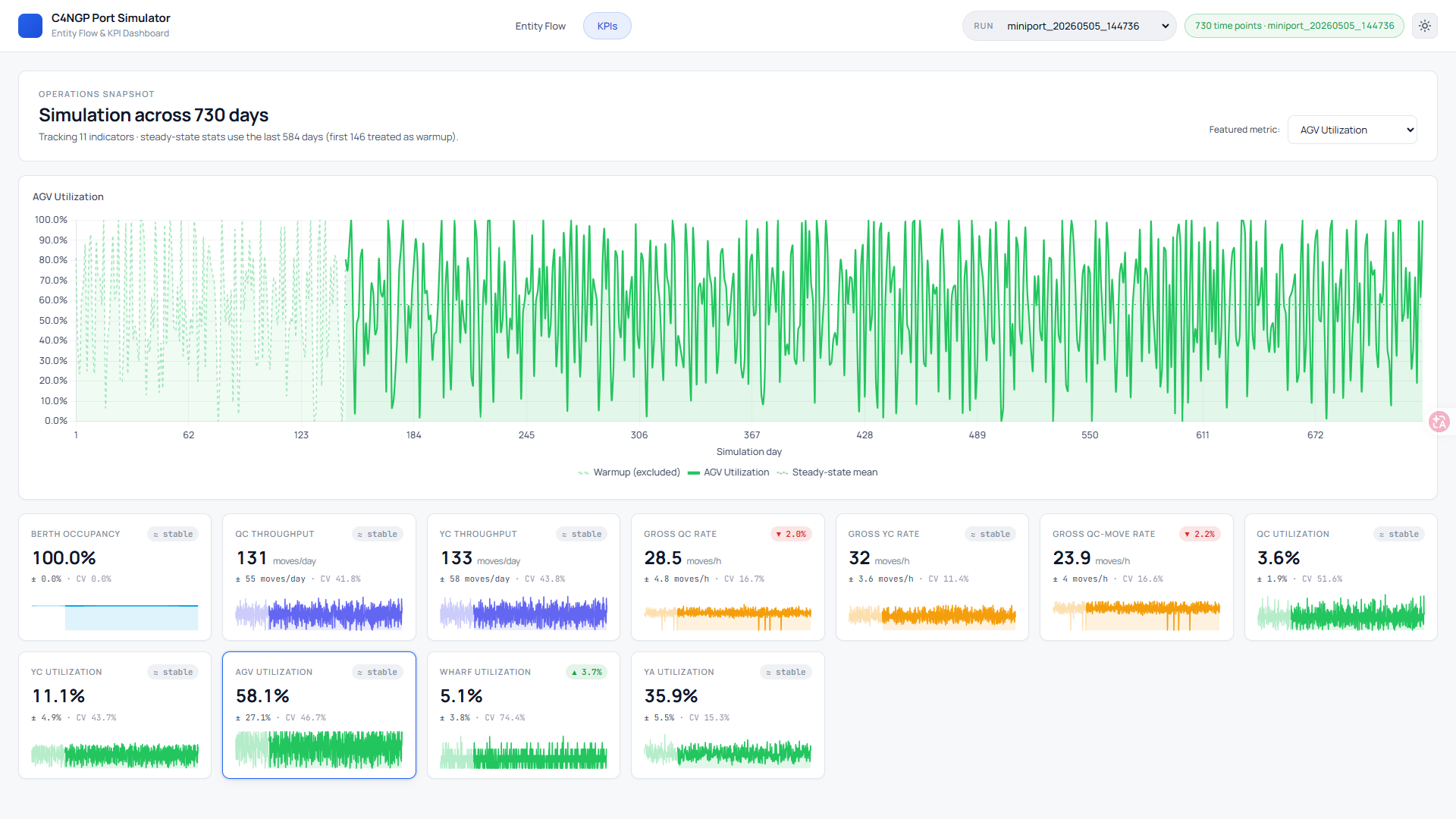
Comprehensive KPIs
Built-in statistical measurement engine tracking GQCR, BOA, WU, TP, QCAC, YCAC, and AGVAC for thorough operational analysis.
Four Integrated Modules
Ships flow through the Sea module, Anchorage, Terminal, and finally return to sea — with the Terminal module encapsulating the full quay-to-yard-to-transport operations.
Sea Module
Generates PortCalls and initialises container attributes (transshipment, import, export). The ShipForAWeek activity pre-generates export containers before vessel arrival.
Anchorage
Simplified infinite-capacity anchorage model. Vessels wait here before berthing — no travel time assumed for transit to terminal.
Terminal
The operational core — manages QuaySide, Transportation, and YardSide sub-modules covering the full container lifecycle.
QuaySide
Berth allocation, QC scheduling, vessel loading & discharging
Transportation
AGV routing, path planning, yard allocation strategies
YardSide
YC stacking, dwell, reshuffle correction, block management
Land Module
Generates export containers via ShipForAWeek signal. Export containers are homogenised and arrive uniformly to suppress peak YC occupancy.
Container Entity Flow

Built-In Statistical Measurement
Seven operational KPIs tracked natively by the simulation engine — no post-processing required.
Built on Proven Foundations
-
O²DES FrameworkDiscrete-Event Simulation kernel — Object-Oriented .NETunder MIT license
-
PortML.DocumentsPort layout file parsingunder MIT license
Developed in C# on the .NET platform, SingaPort Hybrid Foundation leverages the O²DES framework as its simulation backbone, extending it with a novel hybrid event/activity-based methodology.
Third-party open-source components are all MIT-licensed, ensuring full transparency and commercial compatibility.
System/subsystem model or prototype demonstration in a relevant environment — approaching commercial deployment.
Real-World Applications
A tool for port operators, planners, and researchers to evaluate capacity, layouts, and operational strategies before committing capital investment.
Port Capacity Prediction
Forecast maximum throughput under different vessel mix, equipment counts, and operational policies — before any physical investment.
Layout & Scenario Evaluation
Compare alternative terminal layouts, berth configurations, and yard block designs using the same simulation engine and KPI framework.
Operation Strategy Validation
Test and validate yard allocation algorithms, AGV dispatching rules, and QC scheduling strategies against baseline and benchmark scenarios.